Business Connectivity & Resilience
What happens when your primary connection disappears?
Direct-to-device satellite services are becoming another connectivity option. The resilience question still comes first.
9 min read — Altitude IT Operations Team
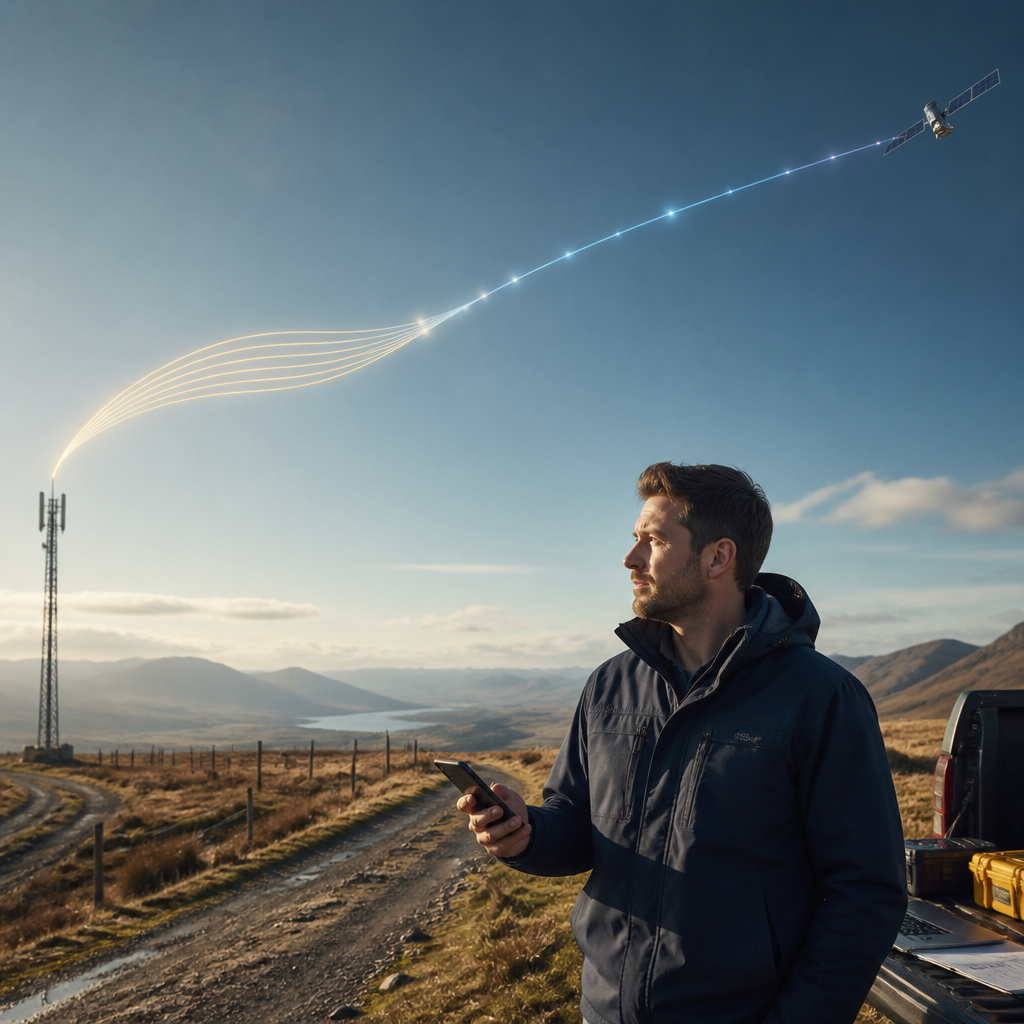
Many businesses describe connectivity as if it were a utility they simply have. In practice, it is a dependency underneath email, cloud applications, payments, voice, remote support, security alerts and everyday communication.
That dependency becomes visible when the normal connection disappears:
- the office broadband fails;
- a mobile mast has a fault or loses power;
- staff work somewhere without terrestrial mobile coverage;
- a remote site loses its connection;
- an engineer needs communication in a rural location; or
- a cloud service is available but the business cannot reach it.
The right opening question is not “Should we buy satellite?” It is:
What happens to your business when the normal connection disappears?
Direct-to-device satellite is one more option
Direct-to-device, or satellite-to-mobile, services use satellites to connect compatible mobile devices in places where the ordinary mobile network does not reach. The aim is to provide an additional path without requiring a separate satellite phone or large dish in every use case.
In the UK, O2 Satellite is an example of this type of service. O2 says it sits alongside its main mobile network, works with compatible smartphones without extra hardware or an app, and supports services including text messaging, location sharing and selected apps. O2 also states that standard voice calls, including emergency calls, are not supported through O2 Satellite and that performance is best outdoors with a clear view of the sky.
Starlink's Direct to Cell information lists Virgin Media O2 as a UK mobile partner and describes messaging and data capabilities that vary by service, device and network partner. Ofcom has also published the UK regulatory framework for authorising direct-to-device satellite services. Those developments make satellite-to-mobile a real option to assess, not a reason to treat it as equivalent to full fibre, 4G or 5G connectivity.
What it may help with
Satellite-to-mobile can be useful where the problem is the last gap in terrestrial coverage and the requirement is modest. Depending on the service, device and location, examples may include:
- sending a message from a rural work site;
- sharing a location with a colleague;
- using a supported low-bandwidth application;
- providing an additional route for mobile staff who regularly travel beyond coverage; or
- maintaining a basic communication channel while a wider incident is being assessed.
It may not provide the same capacity, latency, application support or reliability as a fixed connection or a strong terrestrial mobile signal. Buildings, trees, terrain, weather, device compatibility, coverage areas and provider terms can all affect the outcome.
Map the dependency before choosing the technology
Different business functions need different levels of connectivity. A field engineer may need short messages and location sharing. A payment terminal may need a stable transactional connection. A call centre may need low-latency voice and access to multiple cloud systems. A remote CCTV installation may need a separate design altogether.
For each important function, record:
- what stops working when connectivity is lost;
- how long the business can tolerate that interruption;
- which people, sites and applications are affected;
- whether work can continue offline temporarily;
- what alternative connection paths already exist; and
- what the financial, safety or customer impact of failure would be.
This often reveals that resilience is not one purchase. It may involve a backup connection for the office, a mobile hotspot for a small team, offline procedures for a key application and a separate communication plan for remote staff.
Think in alternative paths
A simple resilience map might look like:
- Primary broadband → secondary broadband or mobile. A second path can help when the main circuit or local equipment fails, although two services may still share ducts, power or local infrastructure.
- Terrestrial mobile → satellite. A satellite-to-mobile service may extend basic communication into a coverage gap, subject to compatible devices, supported services and a clear view of the sky.
- Cloud system → appropriate offline contingency. A documented temporary process may be more useful than buying another connection for a system that cannot operate meaningfully on a weak link.
The paths should be tested against the failure they are meant to address. A second connection from the same provider may not help with a provider-wide incident. A satellite service may not help an indoor meeting room. An offline procedure that exists only in someone's memory is not a dependable contingency.
Do not buy every available option
A business should not automatically buy leased line, broadband, 5G and satellite simply because all four technologies exist. That can create cost, management overhead and false confidence without solving the most likely failure.
Choose proportionately based on:
- operational dependency;
- acceptable downtime;
- location and coverage;
- staff and customer requirements;
- the cost of failure;
- available alternatives; and
- how often the fallback will be tested.
For some businesses, a low-cost secondary connection and a clear restart procedure may be enough. For others, a remote site may justify a more robust design. The requirement should determine the technology, not the other way around.
Frequently Asked Questions
Is satellite-to-mobile a replacement for broadband?
Usually not. It can provide an additional communication path in some coverage gaps, but service capability, throughput, device support, latency and availability vary. Treat it as one resilience option rather than a universal replacement for a primary business connection.
Can O2 Satellite make emergency calls?
O2's current help information says standard voice calls, including emergency calls, are not supported on O2 Satellite and that the service should not be relied on for contacting emergency services. Check the provider's current information before making any safety-critical assumption.
What should a business test first?
Test the business function, not just whether a device shows a signal. Confirm which people can communicate, which applications work, how long the fallback lasts, what information is available offline and who decides when to switch back to normal service.
Requirement first. Technology second.
Connectivity resilience is part of business continuity. The useful outcome is not a list of fashionable technologies; it is a clear answer to what the business can continue doing when the normal connection disappears.
If the answer is “We stop”, the resilience requirement is worth investigating. Altitude IT can help map dependencies, compare proportionate options and turn the result into a practical continuity plan through technology advice and IT operations support.